
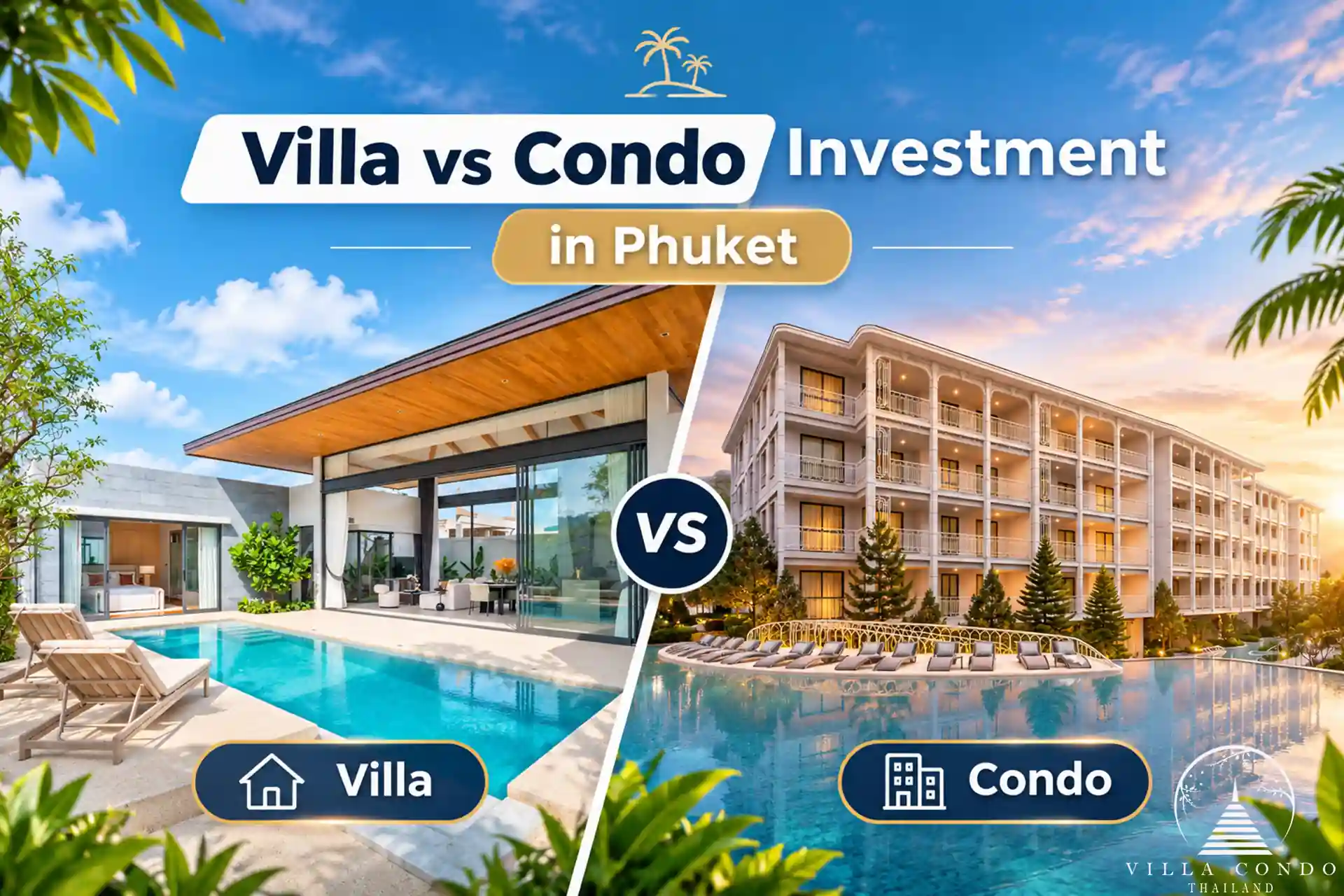
Villa vs Condo Investment in Phuket: Which Is Better?
Phuket has become an established destination for international property buyers, attracting investors, retirees, expatriates and families looking for a second home in Thailand.
For many buyers, one of the first decisions is whether to invest in a private pool villa or a condominium.
Both offer opportunities for rental income, personal use and potential long-term capital appreciation. However, they differ significantly in purchase price, operating expenses, ownership arrangements, rental strategies and resale considerations.
So, which is the better investment in Phuket: a villa or a condo?
The answer depends on your budget, investment objectives, risk tolerance and how you intend to use the property.
This guide compares both options, including their potential financial returns and practical considerations for foreign investors.
1. Phuket Property Investment Market in 2026
Phuket’s residential property market has evolved significantly in recent years, with growing interest in both resort-style condominiums and private pool villas.
According to the Colliers Phuket Residential Report 2025–2026, international demand remains an important driver of the market. However, demand varies across property types, locations and price segments.
The report also highlights increasing competition among condominium developments and sustained interest in low-density residential properties.
Meanwhile, Krungsri Research’s Phuket Housing Outlook 2026–2028 identifies continued foreign interest in condominiums alongside slower villa sales and rising inventory in certain segments.
These findings suggest that Phuket’s property market should not be viewed as a single investment category.
A well-located condominium and a premium private pool villa may appeal to entirely different tenants and buyers.
For investors, the property’s individual characteristics matter more than broad claims that Phuket real estate will always appreciate.
2. Villa vs Condo: Key Investment Differences
| Investment Factor | Private Pool Villa | Condominium |
|---|---|---|
| Initial investment | Generally higher | Generally lower |
| Rental income per property | Potentially higher | Typically lower |
| Maintenance costs | Higher and more variable | Generally more predictable |
| Property management | Easy to outsource; higher maintenance needs | Easy to outsource; generally lower maintenance needs |
| Foreign freehold ownership | Land ownership generally restricted | Available to eligible foreigners within the legal quota |
| Typical tenants | Families, groups and long-term residents | Individuals, couples and smaller households |
| Personal use | More space and privacy | Convenience and shared facilities |
| Resale considerations | Often a narrower buyer market | May reach a broader buyer pool at lower price points |
These are general differences rather than fixed rules. Actual performance depends on the property’s price, location, quality, management and legal structure.
3. Investing in a Private Pool Villa in Phuket
Private pool villas are popular among buyers who value space, privacy and a more independent residential lifestyle.
A typical three- or four-bedroom villa may include a private swimming pool, garden, spacious living and dining areas, multiple bathrooms and covered parking.
Advantages of Villa Investment
Higher rental income per booking or tenancy
A well-positioned villa can command substantially higher rental rates than a small condominium, particularly when it accommodates families or larger groups.
Villas in areas such as Bang Tao, Cherngtalay, Layan and Rawai may appeal to international families, long-stay residents and holiday-home users.
Greater privacy and personal-use flexibility
Villas generally provide more space for families, visiting guests and longer residential stays.
They can also accommodate features such as home offices, outdoor entertainment areas and private gardens.
Distinctive property characteristics
Land size, architectural design, privacy, views and proximity to desirable amenities can differentiate one villa from another.
However, these characteristics do not guarantee stronger capital appreciation.
Disadvantages of Villa Investment
Higher operating expenses
Owners typically need to budget for swimming pool servicing, landscaping, pest control, air-conditioning maintenance, building repairs, insurance and property management.
Repairs to a private pool or major building systems can create substantial unexpected expenses.
Higher capital commitment
A villa generally requires a larger initial investment, leaving more capital concentrated in a single property.
Potentially longer resale periods
Higher-priced properties may attract a smaller pool of buyers.
Investors should consider how quickly they may need to sell and whether the ownership structure is attractive to future purchasers.
In its August 2026 industry outlook, Krungsri Research identified slower absorption of newly developed villa inventory in Phuket. This does not predict the resale time of any individual villa, but it highlights the importance of assessing local supply and buyer demand.
4. Investing in a Condominium in Phuket
Condominiums offer a different investment profile.
They generally require less initial capital and provide shared facilities such as swimming pools, fitness centres, security services and landscaped communal areas.
Many developments are located near beaches, shopping centres, restaurants and established residential communities.
Advantages of Condo Investment
Lower entry cost
Investors can generally enter the condominium market with less capital than would be required for a comparable private pool villa.
This may provide greater flexibility in allocating funds across investments.
Simpler maintenance arrangements
The condominium juristic person typically manages common areas, shared facilities and building-related services.
Owners remain responsible for their own unit, but they generally do not need to maintain a private swimming pool or garden.
Foreign freehold ownership
Eligible foreign buyers can legally own condominium units under freehold ownership, subject to Thailand’s foreign ownership quota and relevant purchasing requirements.
This is an important distinction from villas involving land ownership.
Potential long-term rental demand
Well-located condominiums can attract professionals, couples, expatriates and long-term residents.
However, demand varies significantly according to location, building quality, room size and competing rental supply.
Disadvantages of Condo Investment
Competition from similar units
A development with several hundred apartments may have many units competing for the same tenants.
Similar floor plans and facilities can make it difficult to differentiate individual properties.
Common area fees
Owners must account for ongoing common area maintenance fees, sinking fund contributions where applicable, and possible future special assessments.
Restrictions on property use
Condominium regulations may restrict pets, renovations and rental activities.
Investors should review these rules carefully before purchasing.
5. Rental Yield: What Do the Numbers Actually Mean?
Rental income is often one of the main reasons investors consider Phuket property.
However, advertisements frequently focus on gross rental yields without giving equal attention to operating costs.
There are two important calculations.
Gross Rental Yield
Gross rental yield compares annual rental income with the property purchase price before expenses.
Gross Rental Yield = Annual Rental Income ÷ Purchase Price × 100
Net Rental Yield
Net rental yield accounts for recurring operating expenses and provides a more realistic picture of the income generated by a property.
Net Rental Yield = (Annual Rental Income ? Operating Expenses) ÷ Purchase Price × 100
For a complete investment analysis, buyers should also account for acquisition expenses, financing costs, taxes, major capital expenditures and eventual selling costs.
Example A: Condominium Investment – Long-Term Rental
Consider a hypothetical two-bedroom condominium in Phuket, purchased for THB 8,000,000, with a total living area of 50 sqm.
The property is rented to a long-term tenant for THB 60,000 per month under a 12-month rental agreement, assuming full occupancy throughout the year.
Annual Rental Income and Expenses
| Item | Amount |
|---|---|
| Purchase Price | THB 8,000,000 |
| Property Type | 2-Bedroom Condominium |
| Property Size | 50 sqm |
| Monthly Rental Income | THB 60,000 |
| Rental Period | 12 Months |
| Annual Gross Rental Income | THB 720,000 |
| Real Estate Agent Commission (One Month) | THB 60,000 |
| Common Area Fee (50 sqm × THB 85 × 12) | THB 51,000 |
| Furniture Replacement Reserve | THB 30,000 |
| Minor Repairs & Maintenance | THB 10,000 |
| Insurance & Miscellaneous | THB 5,000 |
| Total Annual Costs & Reserves | THB 156,000 |
| Annual Income After Listed Costs | THB 564,000 |
| Gross Rental Yield | 9.00% |
| Estimated Yield After Listed Costs | 7.05% |
Investment Analysis
In this hypothetical scenario, the condominium generates THB 720,000 in annual gross rental income, representing a gross rental yield of 9%.
After deducting estimated annual operating expenses and furniture replacement reserves of THB 156,000, the property generates THB 564,000 in annual income after listed costs, equivalent to approximately 7.05% of the purchase price.
The calculation assumes the owner pays one month’s rental commission to secure a tenant each year, while the tenant covers everyday utility expenses such as electricity and water.
If the same tenant renews the lease without additional agency fees, the owner’s annual expenses may be lower.
Important: This example assumes 12 months of uninterrupted rent and a relatively strong rental rate. The monthly rent and expenses are illustrative assumptions, not verified market averages. Actual returns may be affected by vacancies, property condition, management arrangements, taxes and unexpected repairs. The calculation excludes acquisition costs, financing, personal income taxes and disposal costs.
Example B: Private Pool Villa Investment – Long-Term Rental
Consider a hypothetical three-bedroom private pool villa in Phuket purchased for THB 20,000,000.
The villa is rented under a 12-month long-term rental agreement, with an estimated monthly rental income ranging from THB 150,000 to THB 180,000.
The following comparison assumes full occupancy throughout the year and an annual real estate agent commission equal to one month’s rent.
Annual Operating Expenses and Reserves
| Expense | Annual Cost |
|---|---|
| Common Area Maintenance Fee (THB 5,000 × 12) | THB 60,000 |
| Swimming Pool Maintenance (THB 3,000 × 12) | THB 36,000 |
| Garden Maintenance (THB 2,000 × 12) | THB 24,000 |
| Repairs & Maintenance Reserve | THB 35,000 |
| Furniture Replacement Reserve | THB 30,000 |
| Property Insurance | THB 12,000 |
| Total Before Agent Commission | THB 197,000 |
Rental Income and Investment Returns
| Item | Scenario A | Scenario B |
|---|---|---|
| Purchase Price | THB 20,000,000 | THB 20,000,000 |
| Monthly Rental Income | THB 150,000 | THB 180,000 |
| Rental Period | 12 Months | 12 Months |
| Annual Gross Rental Income | THB 1,800,000 | THB 2,160,000 |
| Real Estate Agent Commission | THB 150,000 | THB 180,000 |
| Other Annual Costs & Reserves | THB 197,000 | THB 197,000 |
| Total Annual Costs & Reserves | THB 347,000 | THB 377,000 |
| Income After Listed Costs | THB 1,453,000 | THB 1,783,000 |
| Gross Rental Yield | 9.00% | 10.80% |
| Estimated Yield After Listed Costs | 7.27% | 8.92% |
Investment Analysis
In these hypothetical long-term rental scenarios, a THB 20 million private pool villa generates an annual gross rental yield ranging from 9% to 10.8%.
After accounting for annual agency commission, common area fees, swimming pool maintenance, garden care, repairs, furniture replacement reserves and insurance, the estimated yield after listed costs ranges from approximately 7.27% to 8.92%.
Although private pool villas can generate substantial rental income, they also require ongoing maintenance and a larger initial investment than most condominiums.
The actual cost of ownership varies depending on the villa’s size, condition, development fees, maintenance requirements and tenancy arrangements.
If an existing tenant renews without an additional agency commission, annual expenses may be lower.
Important: These examples are hypothetical and assume 12 months of uninterrupted rental income. They are not verified Phuket market averages or guaranteed investment returns. The calculations exclude acquisition expenses, financing, applicable taxes, professional management fees, major unexpected repairs and eventual selling costs. Actual rental income and investment performance may differ significantly.figures exclude financing, acquisition and disposal expenses, and personal tax liabilities.
What Can We Learn?
These hypothetical long-term rental scenarios demonstrate that both condominiums and private pool villas in Phuket can offer attractive rental returns, but their investment requirements and operating expenses differ significantly.
1. Gross Rental Yield
The two-bedroom condominium, purchased for THB 8 million and rented at THB 60,000 per month, generates a 9% gross rental yield.
Meanwhile, the three-bedroom private pool villa, purchased for THB 20 million and rented at THB 150,000–180,000 per month, generates a 9%–10.8% gross rental yield.
This demonstrates that both property types can produce competitive returns when purchased at the right price and rented at achievable market rates.
2. Returns After Operating Costs
After deducting estimated annual expenses, including agent commissions, common area fees, maintenance, furniture replacement reserves and insurance:
- Condominium: Approximately 7.05% annual yield after listed costs.
- Private Pool Villa: Approximately 7.27%–8.92% annual yield after listed costs.
Although villas can generate higher rental income, they also require greater capital investment and more extensive maintenance.
3. Investment Budget and Risk
The condominium requires THB 8 million in initial capital, compared with THB 20 million for the villa.
A lower entry price may provide investors with greater financial flexibility, while villas offer higher rental income potential but concentrate more capital in a single property.
Unexpected repairs, vacancy periods and changes in rental demand can affect both investments.
4. Long-Term Rental Stability
Both examples assume a 12-month rental agreement with uninterrupted rental income.
Long-term rentals can provide more predictable cash flow and reduce tenant turnover compared with short-term holiday rentals.
However, a 12-month lease does not eliminate vacancy, non-payment or tenant renewal risks.
5. The Better Investment Depends on the Individual Property
A villa does not automatically outperform a condominium, and a condominium is not necessarily a safer investment.
The most important factors are the purchase price, achievable rental income, operating costs, ownership structure, location and long-term resale potential.
Ultimately, investors should focus on realistic returns after expenses rather than advertised gross rental yields alone.
Important: These figures are illustrative investment scenarios, not verified Phuket market averages or guaranteed returns. They assume full occupancy and exclude acquisition costs, financing, applicable taxes and eventual selling expenses. Actual investment performance may vary.
6. Short-Term vs Long-Term Rental Strategies
Another important consideration is how the property will be rented.
Long-Term Rental
Long-term rentals generally involve tenants occupying the property for several months or longer.
Advantages may include more predictable occupancy, lower tenant turnover and reduced marketing or housekeeping requirements.
However, long-term rental rates may be lower than the nightly rates advertised for holiday accommodation.
Short-Term Holiday Rental
Short-term holiday rentals can generate higher revenue during periods of strong tourist demand, but income may fluctuate considerably.
Additional expenses may include cleaning, guest communication, booking platform commissions, utilities and professional management.
Investors must also consider Thailand’s accommodation laws.
Under Thailand’s Hotel Act, accommodation offered for short stays may require appropriate licensing or a lawful exemption. Ordinary condominium units generally cannot be operated as hotels, as clarified by the Department of Lands in November 2023.
Monthly rental arrangements are treated differently, but condominium rules and other legal obligations still apply.
For further information, see the legal analysis by Tilleke & Gibbins on condominium hotel operations.
Before purchasing any rental investment, buyers should verify that their proposed rental strategy is legally permitted.
7. Foreign Ownership: Villas vs Condominiums
Ownership structure is one of the most important differences between investing in a villa and a condominium in Thailand.
Condominium Ownership
Eligible foreign buyers may purchase condominium units under freehold ownership, provided that foreign ownership does not exceed 49% of the total unit floor area of the registered condominium development.
Buyers must also meet the relevant legal and foreign-currency documentation requirements.
Villa Ownership
Foreign individuals are generally restricted from directly owning land in Thailand, apart from narrow statutory exceptions.
For villa purchases, a registered land lease may be considered, with separate building ownership possible in appropriate circumstances.
Ordinary long-term land leases are generally limited to an initial registered term of 30 years.
Future renewals are not automatically guaranteed, even when developers advertise arrangements such as 30+30+30 years.
The legal rights, remaining lease duration, transferability and obligations of the landowner can affect both the property’s value and its resale potential.
For further guidance, visit our Phuket Property Buyer’s FAQ, which explains foreign ownership, leasehold arrangements and common purchasing considerations.
Foreign buyers should always seek independent legal advice before entering a purchase or long-term lease agreement.
8. Which Areas in Phuket Are Worth Considering?
Both villa and condominium performance depend heavily on location.
Bang Tao and Cherngtalay
Bang Tao and Cherngtalay provide access to established shopping areas, international schools, restaurants, beach clubs and residential communities.
These characteristics may appeal to expatriates, international families and buyers considering longer-term residence.
The area includes both premium condominiums and private pool villas.
Rawai and Nai Harn
Rawai and Nai Harn offer an established residential environment in southern Phuket.
These neighbourhoods attract interest from retirees, expatriates, remote workers and families looking for a more relaxed lifestyle.
Buyers can explore different residential options through our Rawai property listings.
Kamala
Kamala offers a coastal setting with a mixture of resort-style condominiums, residential properties and luxury villas.
The area’s appeal varies depending on proximity to the beach, hillside location, access roads and surrounding facilities.
Explore our properties for sale in Kamala, Phuket to compare available options.
Phuket Town and Central Phuket
For investors focusing primarily on long-term residential tenants rather than holiday accommodation, central Phuket may also be worth evaluating.
Access to workplaces, schools, hospitals, supermarkets and shopping centres can be important considerations for year-round residents.
No single area guarantees strong rental income or capital appreciation. Investors should compare properties with similar specifications and actual rental evidence.
9. Capital Appreciation and Resale Potential
Rental yield is only one part of the investment decision.
Some buyers may prioritise long-term capital appreciation or the option to resell their property in the future.
For condominiums, factors such as building management, maintenance quality, location, competing developments and remaining foreign freehold availability may influence resale appeal.
For villas, land location, building condition, ownership rights, accessibility and ongoing maintenance requirements can play a significant role.
Importantly, the original developer’s asking price is not necessarily the same as the price a resale buyer will pay.
Investors should review comparable resale transactions where available, rather than relying exclusively on new-development advertising.
A projected increase in property value should never be treated as a guaranteed investment return.
10. Five Questions to Ask Before Investing
Before deciding between a villa and a condominium, consider these five questions.
1. What is my investment budget?
Include acquisition costs, furniture, legal fees, maintenance and a reserve for unexpected expenses.
2. Am I buying primarily for rental income or personal use?
A property that is ideal for family holidays may not produce the strongest financial return.
3. What is the realistic net rental yield?
Use comparable rental evidence, vacancy assumptions and complete operating expenses.
4. What ownership rights will I receive?
Understand the difference between condominium freehold ownership, land leasehold and any separate building ownership arrangements.
5. How easy might the property be to resell?
Consider the likely buyer audience, competition, ownership documentation and market conditions.
11. Villa or Condo: Which Is the Better Investment?
There is no universal winner.
A private pool villa may be more suitable for investors with a larger budget who value privacy, family accommodation, distinctive design and the potential for higher rental income per property.
A condominium may be more suitable for investors seeking a lower entry cost, relatively straightforward maintenance, access to shared amenities and the possibility of foreign freehold ownership.
The better financial investment is the property that meets your objectives at a justifiable purchase price, with a realistic rental strategy and an ownership structure you fully understand.
In Phuket, the quality of an individual investment often matters more than whether it is classified as a villa or a condominium.
Final Thoughts
Both villas and condominiums can play a role in a Phuket property investment strategy.
The key is to look beyond attractive architectural designs, promised rental returns and developer marketing materials.
A careful investment decision should consider the property’s actual purchase price, realistic net rental income, ownership rights, ongoing expenses, management quality and resale prospects.
At Villa Condo Thailand, we help buyers compare property options across Phuket, including private pool villas, condominiums and residential developments suited to different budgets and lifestyles.
If you are considering investing in Phuket real estate, contact our team to explore available properties and discuss which type of investment may be most appropriate for your objectives.
Market information reviewed: November 2026. Financial examples are hypothetical. This article is for general educational purposes and does not constitute personalised investment, legal or tax advice.


